
US President Donald Trump has claimed that China has committed to halting weapon supplies to Iran, following his personal diplomatic interventions with Chinese President Xi Jinping.

US President Donald Trump received a mixed reception of cheers and boos at the US Open final at Arthur Ashe Stadium in New York on Sunday.

US President Donald Trump has renewed his call for a high-security ballroom at the White House, citing security concerns after a shooting incident near a journalists' dinner he attended.

US President Donald Trump met with Chinese President Xi Jinping in Beijing to discuss trade, technology, Taiwan, and the Iran war. Xi Jinping said that 2026 will be a 'historic, landmark year' for China-US relations.
The US has temporarily permitted India to accept Russian oil already on ships to ensure energy supplies amid the conflict with Iran. This short-term measure is not expected to significantly benefit Russia financially.

US President Donald Trump will visit China from May 13 to 15 at the invitation of President Xi Jinping. The visit occurs amidst global tensions, including the war in West Asia and trade disputes between the US and China. Discussions are expected to cover China-US relations, world peace, and economic issues.

The Indian nationals sanctioned include Varun Pula, who owns Marshall Islands-based Bertha Shipping Inc., which owns and operates Comoros-flagged vessel PAMIR.

US President Donald Trump and Chinese President Xi Jinping met in Beijing to discuss a range of issues, including trade frictions and the war in Iran.
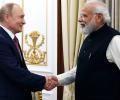
The US House Foreign Affairs Committee Democrats stated that imposing tariffs on India will not deter Russian President Vladimir Putin or address Russia's invasion of Ukraine.

US President Donald Trump is set to visit China for talks with President Xi Jinping on trade, global issues, and the Gulf war. The visit aims to address trade frictions and other key issues, with high expectations for progress.
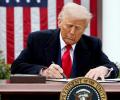
President Donald Trump on Friday signed an executive order retroactively lowering tariffs on a range of agricultural imports, including beef, tomatoes, coffee and bananas, with the change taking effect from November 20, CNN reported.

US President Donald Trump received a red carpet welcome in Beijing for talks with Chinese President Xi Jinping on trade, the Iran war, and other key issues. The visit underscores the importance both nations place on their relationship amid ongoing tensions.

Trump was swiftly evacuated from the White House Correspondents' Dinner after a shooting incident near the venue.
There were apprehensions that additional secondary tariffs would have hit India in case the US decided to enforce them.
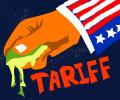
The US is "pretty close" to reaching a "fair trade deal" with India, President Donald Trump has said, adding that he will lower the tariffs imposed on Indian goods at "some point".
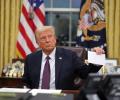
US President Donald Trump has said that tariff negotiations with India are "coming along great," and he thinks the two countries will strike a trade deal.

Chinese President Xi Jinping warned US President Donald Trump that mishandling the Taiwan issue could trigger conflicts between the two countries during wide-ranging talks on trade, Iran, and energy security.

The turning point came with the appointment of Sergio Gor as the US ambassador to India.

US President Donald Trump has said that India should not be "dumping" rice into the United States market and he will "take care" of it, while stressing that tariffs will solve the "problem" easily.

US President Donald Trump has indefinitely extended the ceasefire with Iran at the request of Pakistan, aiming to allow Tehran's leadership time to form a unified proposal to end the seven-week war.

Trump's post on Truth Social comes a day after the US asked G7 countries to impose tariffs on countries purchasing oil from Russia.

The statement did not name any country. But the US has often blamed India and China for purchasing Russian oil even when there are no tariffs on Beijing for it.

Trump claimed that he "got a call from Prime Minister Modi saying, 'we're done'. I said, 'you're done with what?'" Trump said and claimed Modi replied: "We're not going to go to war."
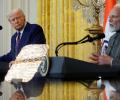
The Trump administration has told the US Supreme Court that it imposed tariffs against India for purchasing Russian energy products as part of its strategy to address the war in Ukraine.
White House press secretary Karoline Leavitt on Tuesday once again claimed that United States President Donald Trump has ended the military conflict between India and Pakistan.

The Swiss government would not object to tennis legend Roger Federer or FIFA President Gianni Infantino intervening to reduce the country's tariff burden after the US slapped a 39 percent import duty on its goods, President Karin Keller-Sutter said.
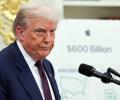
As one of the federal appeal courts in the United States ruled that most of tariffs imposed by Trump administration are not accordance with the laws, US President Donald Trump on Friday (local time) affirmed that all tariffs imposed on the countries will remain in effect, calling a recent ruling by a 'highly Partisan Appeals Court' incorrect.
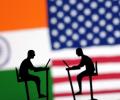
Commerce and Industry Minister Piyush Goyal on Tuesday expressed hope that India will conclude the proposed bilateral trade agreement (BTA) with the US by the fall or November this year. He said that "a little bit" of geopolitical issues overtook the trade matters in the negotiations for the pact between the two countries.

The clock on the ceasefire is running out. But everyone's already whispering about round two, possibly as soon as this weekend.

External Affairs Minister S Jaishankar defends India's purchase of Russian oil, stating it is not the largest purchaser and that the US had previously supported such actions to stabilize energy markets. He also addresses concerns about tariffs and trade relations with the US.

'The entire US ecosystem built over decades at the bases in the Gulf region, especially the UAE, costing trillions of dollars have been decimated, dealing a mortal blow to the US Central Command's war capability,' points out Ambassador M K Bhadrakumar.

Trump stated that Russia will face "severe economic consequences" if Putin doesn't show interest in de-escalating the Ukraine conflict.

The US Department of the Treasury on Wednesday imposed sanctions on Russia's two largest oil companies, Rosneft and Lukoil, in an effort to pressure the Kremlin to end its war in Ukraine.

Both sides have now revealed a preference for escalation over strategic defeat, and each new provocation narrows the space for the next pause. The Touska seizure, Iran's refusal to negotiate under blockade, Israel's strikes on Iranian oil infrastructure -- all of these add up to an increasingly untenable situation. This makes the wild card -- Trump and his motormouth -- more consequential than ever, notes Prem Panicker in his must read blog on the Iran War.
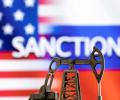
Russia has a "special mechanism" to confront any challenge arising out of the US slapping punitive measures against India for its procurement of Russian crude oil, Russian charge d'affaires Roman Babushkin said on Wednesday.
United States President Donald Trump has announced that Washington DC will stop minting pennies, citing their high production cost, which exceeds their face value and termed the practice "wasteful." President Trump said Sunday that he has instructed Treasury Secretary Scott Bessent to "stop producing new pennies."
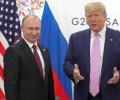
Trump reiterated that he is not negotiating on behalf of Ukraine, but rather aiming to bring the parties to the negotiating table.
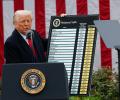
Amid the tumbling stock market in the United States, following the White House clarification of tariffs on China to be at least 145 per cent and an earlier announcement of a 90-day pause on tariffs for over 75 countries, President Donald Trump addressed the challenges associated with his tariff policy, stating that there would be 'transition problems'.

Alliances fight wars effectively only when they share an endgame. If Israel acted without US knowledge, then the military alliance is operating without real coordination at the level of strategic targeting. Neither picture is reassuring in a war that is no longer regional in its consequences. Prem Panicker continues his must read daily blog on the Gulf War.

Communication channels between India and the US are open to resolve the ongoing tariff issues, and the glitch in trade ties is only temporary, given the long-term relationship between the two nations, government sources said on Wednesday. The US' 50 per cent tariffs on Indian exports to America came into effect from August 27, barring a few sectors.
